The Hidden Cost of Siloed Cloud Operations, Security, and Compliance in Multi-Cloud Adoption
Key Takeaways:
- Siloed Teams Are Your Hidden Multi-Cloud Cost: Federal and state agencies gain flexibility with multi-cloud adoption, but fragmented CloudOps, security, and compliance teams create duplicated effort, delayed authorizations, and governance bottlenecks that quietly compound across every stage of the cloud lifecycle.
- Multi-Cloud Environments Increase Complexity: Each cloud provider doesn’t simply introduce another platform; it expands the attack surface and requires updates to security controls, ATO packages, and monitoring strategies. In multi-cloud environments, managing separate control models, compliance requirements, and governance processes transforms manageable complexity into exponential friction.
- Integration Is the Path Forward—and Already Underway: The better approach treats CloudOps, security, and compliance as an integrated system where security is built into design from the start, authorization is continuous, and all functions share visibility and data. Agencies across the federal and state landscape are already making this practical shift to a mission-centered model.
Operating across multiple cloud service providers gives federal and state agencies greater flexibility, resilience, and access to best-of-breed tools for their missions. But adopting multi-cloud is not the same as operating it well, and the gap between the two is where agencies often encounter significant friction.
Today’s systems must be designed to reduce risk from the start and adapt as conditions change. That requirement has exposed a structural problem: Cloud Operations (CloudOps) teams build and manage cloud services. Security teams implement and monitor controls to protect them. Compliance and Authority to Operate (ATO) teams assess whether those controls meet policy requirements and formally authorize the system to operate. But rather than working as an integrated team, they function as three independent workstreams.
This misalignment compounds quietly across every stage of the cloud lifecycle, leading to duplicated effort, delayed ATO decisions, rework triggered by late-stage risk findings, inconsistent financial management actions and timing, and governance structures that slow decisions instead of enabling them.
Multi-Cloud Multiplies the Coordination Burden
Every new cloud service provider an agency adopts introduces more than another platform to manage. It expands the attack surface and materially changes the underlying security architecture.
That shift requires updates to security control implementations, revisions to the ATO package and adjustments to the continuous monitoring strategy. Meanwhile, each cloud service provider brings its own control models, compliance requirements, operational tooling, and governance processes. Even when providers align to federal frameworks, control inheritance and implementation can differ in meaningful ways.
In a single-cloud environment, complexity is manageable. In multi-cloud, however, complexity does not simply increase; it multiplies.
How Siloed Operations Look in Practice
As they adopt multi-cloud, agencies across the federal and state landscape are navigating a common set of challenges that stem directly from this fragmented operating model.
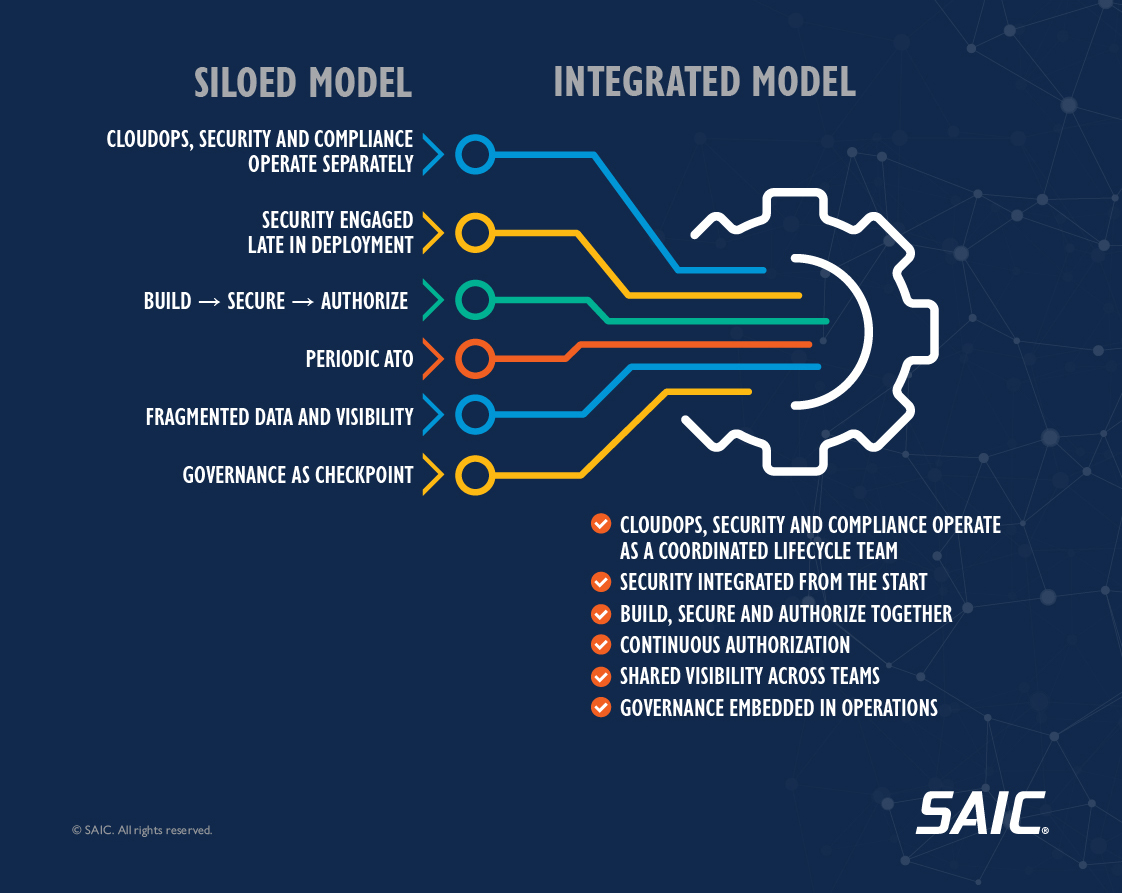
Security engaged late in the lifecycle.
In many organizations, cybersecurity still operates independently from cloud architecture and DevSecOps pipelines. Security reviews often occur after key deployment decisions have already been made. Findings surface late, triggering rework, delays, and inconsistent enforcement of security baselines. Instead of shaping architecture from the outset, security becomes a corrective function.
ATO processes built for static systems.
Traditional ATO processes were designed for a slower pace of change, and annual or milestone-based reviews made sense when systems were relatively static. That isn’t the case in a multi-cloud environment, where configurations change daily and new services are spun up continuously. The issue isn’t the Risk Management Framework itself. It’s the absence of modular ATO processes, reusable control implementation, and automated evidence collection that support ongoing authorization rather than periodic reassessment.
Limited and inconsistent visibility.
When CloudOps, security, and compliance data lives in separate systems managed by separate teams, no one has a complete picture. CloudOps teams may know what’s running but not whether it’s compliant. Security teams may know the policy requirements but not the current state of deployed resources. Compliance and ATO teams may be working from documentation that’s already out of date by the time it’s reviewed. This fragmentation also makes it harder to consistently access and deploy tools across environments, further slowing teams and limiting the ability to take advantage of innovation available within cloud service provider marketplaces.
Governance as a bottleneck.
When risk data is fragmented, routine decisions require reconciliation across multiple stakeholders. Approvals that should be straightforward become extended coordination exercises. Governance devolves into an outer checkpoint instead of an integrated function, slowing deployment cycles, and pushing teams toward work-arounds that introduce new risk.
The Challenges Are Real but Not Inevitable
Click image to enlarge, ESC to close.
It’s important to acknowledge that the siloed model evolved naturally from organizational structures that predated cloud adoption. CloudOps, security, and compliance were separate disciplines long before multi-cloud was a reality, and the processes built around them reflected a different era of IT.
But the operating environment has changed, and the model needs to change with it.
There is a better approach that treats CloudOps, security and compliance not as three separate worlds but as an integrated system of systems. Instead of building a service, securing it, and auditing it in sequence, agencies can align these functions so they operate together with the client mission experience at the center.
In this integrated model, security is built into the design process from the start; authorization is continuous rather than periodic; and operations, compliance, and governance share visibility and work from the same data.
The path from siloed operations to this integrated, mission-centered model is practical, it’s achievable, and it’s already underway in agencies across the federal and state landscape.
In our next post, we’ll walk through the practical steps agencies are taking to make that shift and show what the integrated model looks like in practice.
Download the Infographic for a quick, visual summary.
Frequently Asked Questions
Multi-Cloud Operations, Security, and Compliance
Explore common questions about siloed cloud operations, continuous authorization, and how agencies can align CloudOps, security, and compliance across multi-cloud environments.
Understanding the Problem
The Multi-Cloud Challenge
The Integrated Approach
Getting Started
About the Authors: